

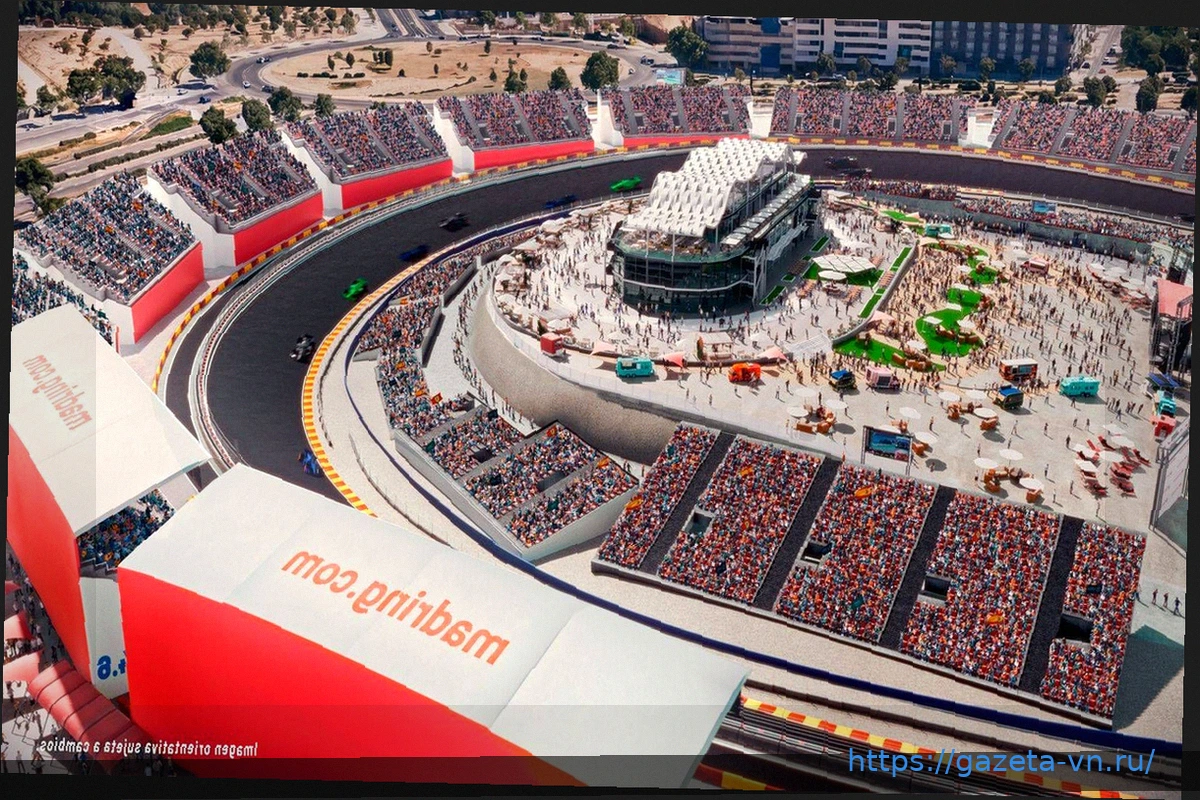
El Confidencial has had the opportunity to visit the Madrid F1 circuit at Ifema, where the Formula 1 Spanish Grand Prix will be held for the next ten years. One of its most spectacular features is the «Monumental,» an unprecedented 550-meter parabolic curve with a maximum gradient of 24%, a unique feature among circuits worldwide.
However, the spectacularity of the Monumental could be jeopardized by the current regulations as seen in the first three Grands Prix of 2026. According to Fernando Alonso, major curves in the championship have become «recharge zones,» as observed at Suzuka’s 130R. The primary allure of the Madrid circuit could be neutralized by the current generation of F1 cars.
In recent days, leading up to the Miami Grand Prix, technical directors and team leaders have been meeting with the FIA to refine the regulations. However, Formula 1 CEO Stefano Domenicali has hinted at limitations for the extent of these changes, referencing Formula 1 from the 1980s.
The new regulations have led to counterintuitive training for drivers, limiting their ability to push to the limit and making them dependent on algorithms. Dynamics of energy management, outside of their control, influence available power. Significant speed differentials between cars create dangerous situations, as witnessed in Oli Berman’s accident at Suzuka. These are the defining factors of the new regulations thus far.
A side effect is an increase in overtakes or position changes. «Overtaking another car as if it were standing still is not part of Formula 1’s DNA. For me, these overtakes are not Formula 1,» stated Carlos Sainz in Shanghai. Fernando Alonso echoed this sentiment, saying, «No, it’s no fun. The overtakes happening now are unintentional. Suddenly, you find yourself with a superior battery to the car in front, and you either crash into it or overtake it.»
However, Domenicali disagrees with those who critique the current racing. «Some say overtaking is artificial, what is artificial? I mean, an overtake is an overtake. People have short memories because in the turbo era of the 80s, I followed Formula 1 then, the technique of lifting off the accelerator and letting the car coast existed, using different turbos and different speeds,» stated the F1 boss. «Because the fuel tank was too small. Perhaps some veterans who criticize or make comments have short memories, because in the 80s, during the turbo era, these things already existed.»
«Lots of action, which is what people want»
Regardless of the debate this stance generates, Domenicali has adopted the role of commercial promoter. According to the Italian, Formula 1 has gained appeal for a wider audience due to increased on-track action, without distinguishing between traditional overtakes and position changes, as F1 drivers question.
«If I observe what is happening worldwide with new Formula 1 fans, the result is magnificent. Everyone is asking: ‘What is happening?’ Lots of action, and that’s what people want to see,» said Domenicali, referring to the theoretical audience growth in major markets after the initial races. In other words, position changes – rather than strict overtakes – attract a broader audience. Conversely, the Italian dismisses the criticism.
«What I don’t like is people who love to criticize. Criticizing for the sake of criticizing helps no one and, in reality, has no effect.» Dismissing those who question the current regulations, Domenicali overlooks that the primary critics are the drivers. Nor should we forget the fans who see a loss of the competition’s essence in this new format. The Italian forgets that in the turbo era, the driver controlled that consumption, limited for safety reasons due to the extraordinary power of those engines. Today, the algorithm has replaced the driver’s use of the throttle and accelerator.
A tightrope walk
What Domenicali makes clear is that FOM will try to ensure future changes do not ruin the on-track spectacle. The F1 boss indicates that qualifying sessions will be updated to avoid embarrassing situations where a driver is penalized for pushing to the limit on a flying lap due to software limitations.
Increased battery charging speed, reduced power delivery compared to current limits (350kW), and modifications to electrical storage limits are all solutions under study. These would, in principle, imply slower cars. Modifying fuel flow to the thermal part would be the most extreme and impactful solution, though perhaps less plausible given the combustion configuration of these engines. Not to mention the manufacturers’ intention not to lose the label and message of 50/50 thermal and electric energy, which has been so boasted about.
For instance, eliminating boost or overtake buttons would reduce the speed differential between two cars in different load situations, or give drivers fewer overtaking resources. However, it would also reduce the on-track «dance» that Domenicali enjoys so much, and, according to him, a wide audience. In essence, it seems an attempt to cover both head and feet with the blanket, with the danger of one part being left exposed.
Over the next month, the extent of the correction to this Formula 1 will become known, with changes to be introduced gradually. How this desired technical and spectacular balance will be achieved appears to be a feat for tightrope walkers. Otherwise, the «Monumental» curve of the Madrid circuit could be diluted during a Grand Prix like a sugar cube.